A Unified Benchmark for Aerial-Enhanced Autonomous Driving
KITScenes Aerial extends KITScenes Multimodal with spatially aligned aerial imagery and learned feature representations, complementing its synchronized onboard sensor data, vehicle poses, and rich Lanelet2 HD map annotations. By exposing road structure beyond the immediate perception range of onboard sensors, it provides a unified foundation for aerial-enhanced autonomous driving research.
The extension combines 20 cm/px RGB orthophotos with neural representations derived from 8 cm/px aerial imagery. It supports a wide range of aerial-enhanced automated driving research, including aerial-only map construction, aerial-assisted online HD mapping, and cross-view localization.
Data access: The Aerial extension is available through the existing KITScenes API and dataset distribution.
The DOP20 orthophotos come with every download; the DINOv3 feature tiles with the full
download (kitscenes download $KITSCENES_ROOT) or with
--aerial-features.
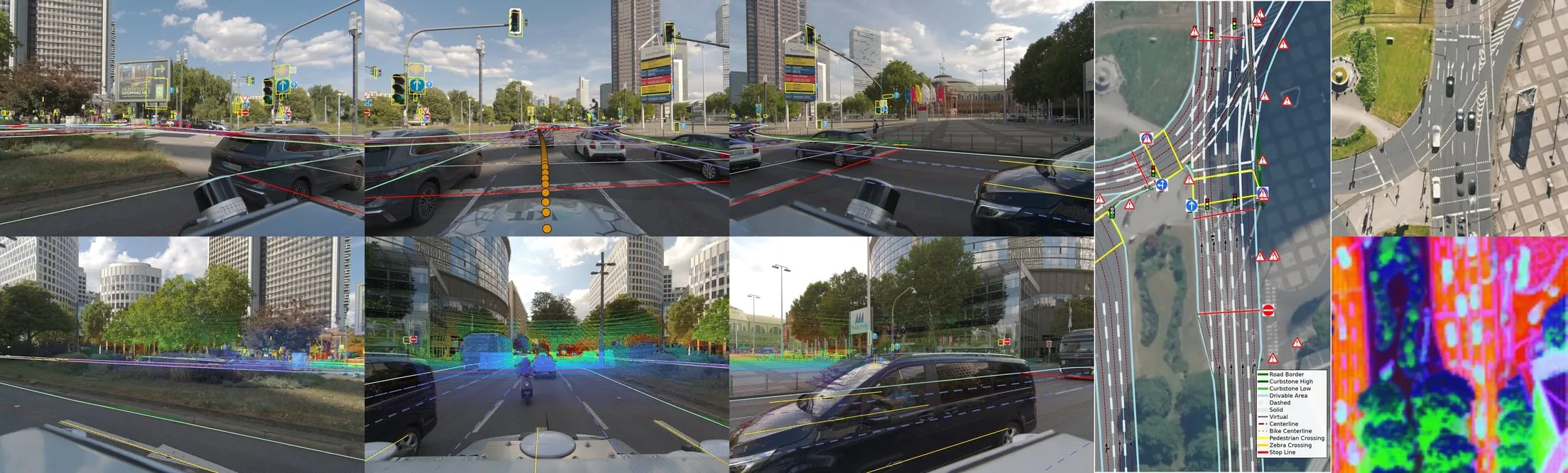
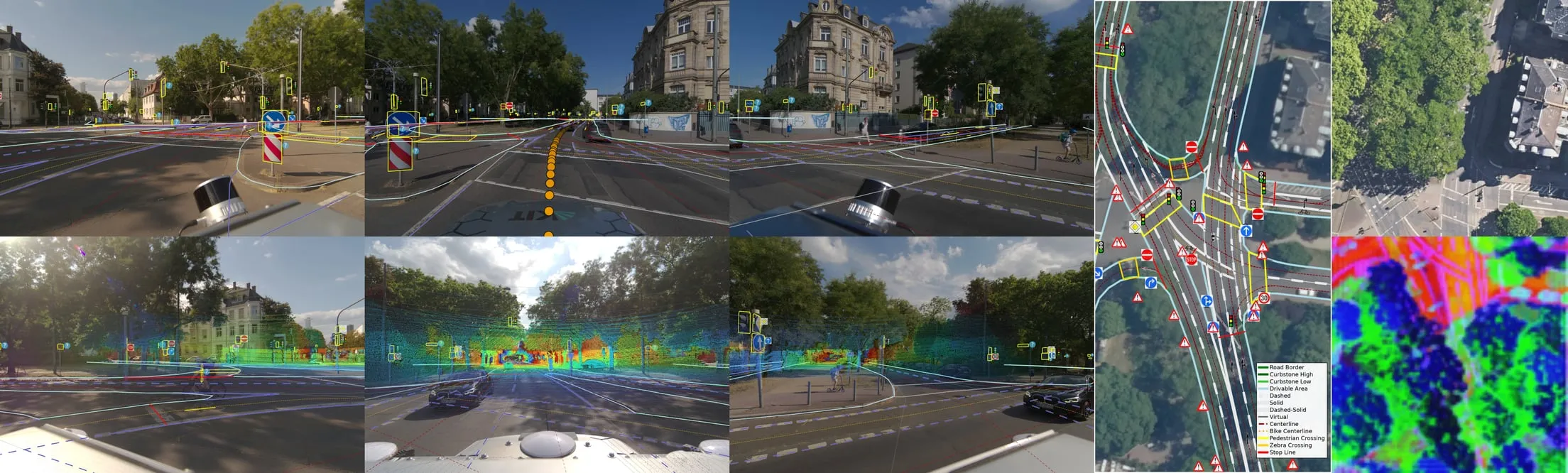
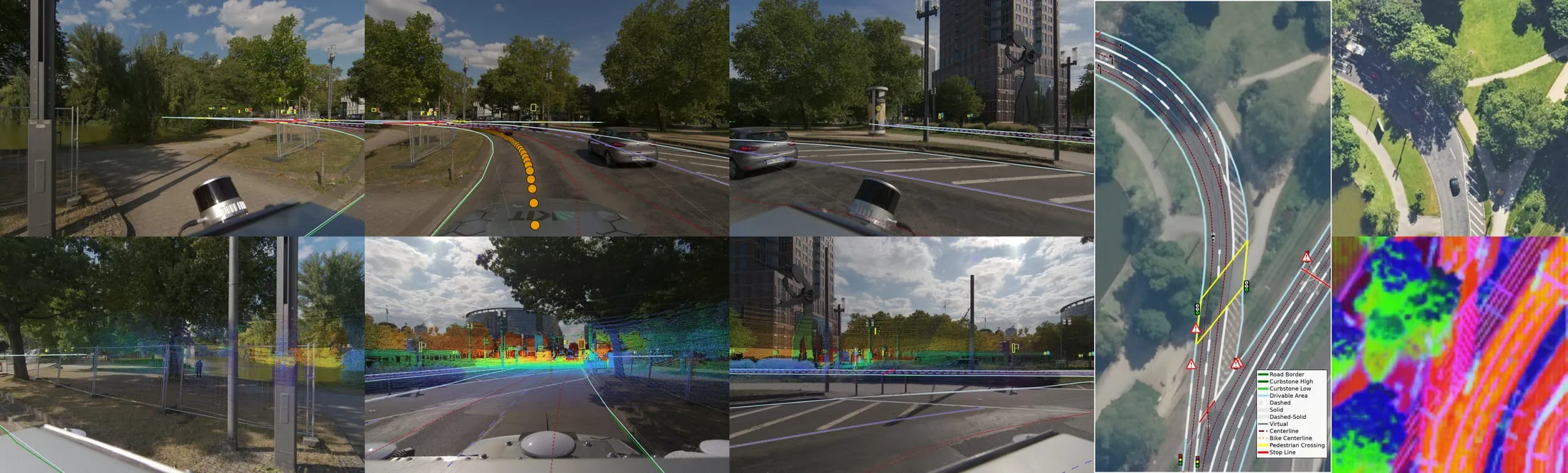
Freely available DOP20 orthophotos on a north-up tile grid.
Spatially continuous features from 8 cm/px municipal orthophotos.
Ego-centered 60 × 30 m crops aligned with the onboard frame.
An upcoming addition, not yet part of v2.0.0.
Per-frame, ego-aligned crops with configurable extent up to 240 × 60 m.
If you use KITScenes Aerial in your research, please cite our works:
The Road Ahead in Autonomous Driving: The KITScenes Multimodal Dataset
@misc{schwarzkopf2026roadaheadautonomousdriving,
  title     = {The Road Ahead in Autonomous Driving: The KITScenes Multimodal Dataset},
  author    = {Richard Schwarzkopf and Fabian Immel and Alexander Blumberg and Jonas Merkert and Nils Rack and Kaiwen Wang and
               Fabian Konstantinidis and Julian Truetsch and Carlos Fernandez and Annika Bätz and Kevin Rösch and Marlon Steiner and
               Willi Poh and Yinzhe Shen and Royden Wagner and Felix Hauser and Dominik Strutz and Jaime Villa and Gleb Stepanov and
               Holger Caesar and Ömer Şahin Taş and Frank Bieder and Jan-Hendrik Pauls and Christoph Stiller},
  year      = {2026},
  eprint    = {2606.02956},
  archivePrefix = {arXiv},
  primaryClass  = {cs.CV},
  url       = {https://arxiv.org/abs/2606.02956}
}
A Unified Benchmark for Aerial-Enhanced Autonomous Driving: The KITScenes Aerial Dataset
@misc{lengerer2026kitscenesaerial,
  title     = {A Unified Benchmark for Aerial-Enhanced Autonomous Driving: The KITScenes Aerial Dataset},
  author    = {Daniel Lengerer and Richard Schwarzkopf and Jonas Merkert and Fabian Immel and
               Rupert Polley and Frank Bieder and Jan-Hendrik Pauls and J. Marius Zöllner and
               Klaus Bogenberger and Christoph Stiller and Carsten Markgraf},
  year      = {2026},
  eprint    = {2610.40455},
  archivePrefix = {arXiv},
  primaryClass  = {cs.CV},
  url       = {https://arxiv.org/abs/2610.40455}
} 








The authors gratefully acknowledge the scientific support and HPC resources provided by the Erlangen National High Performance Computing Center (NHR@FAU) of the Friedrich-Alexander-Universität Erlangen-Nürnberg (FAU) under the BayernKI project v153eb. BayernKI funding is provided by Bavarian state authorities.
The research leading to these results is partially funded by the German Federal Ministry for Economic Affairs and Energy within the project NXT GEN AI METHODS (Grant Agreement No. 19A23014), and by the Shift2SDV project (Grant Agreement No. 101194245), co-funded by the European Union through the Chips Joint Undertaking and its members. The authors gratefully acknowledge the computing time provided on the high-performance computer HoreKa by the National High-Performance Computing Center at KIT (NHR@KIT). This center is jointly supported by the Federal Ministry of Education and Research and the Ministry of Science, Research and the Arts of Baden-Württemberg, as part of the National High-Performance Computing (NHR) joint funding program. HoreKa is partly funded by the German Research Foundation (DFG). The authors also gratefully acknowledge the support of the Large Scale Data Facility (LSDF) at the Karlsruhe Institute of Technology, funded by the Ministry of Science, Research and the Arts of Baden-Württemberg and by the Federal Ministry of Education and Research.





 API
 Download