Can a world model imagine what happens next in a snowstorm, a road closure, or at night? Given the past of a long-tail scenario, generate the next five seconds of six-camera video, optionally together with the planned ego trajectory. Generated futures must look real and move consistently: across all cameras, and with the plan.
For every test scenario, generate an H.264 video per camera with exactly 25 frames at 5 fps, covering 0.2 to 5.0 s into the future, at the KITScenes aspect ratio (e.g. 876 × 568). Only the front camera is required, but ego-motion coherence needs all six and perceptual quality weights the other five cameras too. A trajectory file with 25 (x, y) points per scenario is optional; without it, EMC, MMS and L2 are N/A. Since LongTail v2.1, the val and train splits include the future videos for training.
Live · fetched from HuggingFace · best submission per method · ranked by PQ, ties broken by EMC × MMS
No submissions yet. Be the first!
Could not load leaderboard. View on HuggingFace ↗
Per-type columns show PQ per scenario type. N/A: submitted without a trajectory file.
Submissions are ranked by perceptual quality. Ties are broken by EMC × MMS, which rewards videos whose implied ego motion matches a good plan.
PQ
Perceptual quality
↑ ranking metric
Each camera video is rated by Q-Align (OneAlign), following the perceptual quality metric of WorldMark, mapped to [0, 100] and normalized by the quality of real long-tail calibration videos. The front camera weighs 50%, each other camera 10%; missing or unreadable videos score 0, so front-only submissions reach at most half the maximum.
EMC
Ego-motion coherence
↑ tie-breaker (× MMS)
Recovers the ego motion implied by the videos with optical flow: yaw from the front and rear cameras, which must agree, speed from the four side cameras. Planned and recovered trajectories are split into 0–3 s and 3–5 s and classified into steering and acceleration actions with the SRAC heuristics; a class counts only at similar speed. Needs all six cameras; normalized by real reference videos.
MMS
Multi-maneuver score
↑ tie-breaker (× EMC)
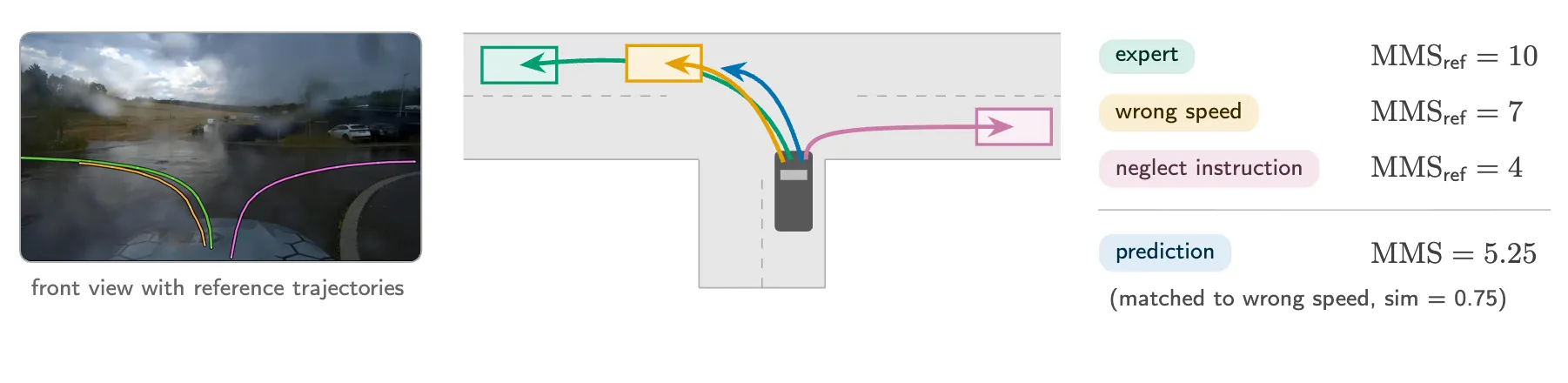
Scores the submitted trajectory against reference maneuvers: expert-like (10), wrong speed (7), neglect instruction (4), off road without crashing (1), crash (0); unmatched 3.5. Comfort penalties of 1 each for jerk more than 44% and tortuosity more than 6% above the reference.
Winners are encouraged to send a 4-minute video of their method, presented at the World Models in Physical AI workshop at NeurIPS 2026 and posted on this website.
The full rules, eligibility and data processing terms are in the challenge Space and apply.





 API
 Download